



Table of Contents
- Why Coffee Scale Calibration Matters for Precision Brewing
- How to Use Calibration Weights (and DIY Alternatives)
- Coffee Scale Accuracy Test: Verify Before You Brew
- Frequently Asked Questions
Last Updated: September 27, 2026
Why Coffee Scale Calibration Matters for Precision Brewing
Coffee scale calibration checks your scale against a known weight and adjusts it so every gram reading is true, which is why knowing how to calibrate your coffee scale for precision matters. When you learn how to calibrate your coffee scale for precision, you protect the brew ratio. At Chilled Iguana Coffee Co., we roast beans from farms all over the world, and those beans deserve honest measurement.
A scale reading two grams heavy ruins a pour-over: your 15-gram dose becomes 13 grams and the cup tastes thin. The load cell drifts from heat, moisture, and heavy jars, and calibration pulls it back in line.
How to Use Calibration Weights (and DIY Alternatives)
Using calibration weights is simple: enter calibration mode, place the certified weight on the platform, and let the scale set its zero point. Most digital scales ask for a 100g, 200g, or 500g weight, so check your manual first.
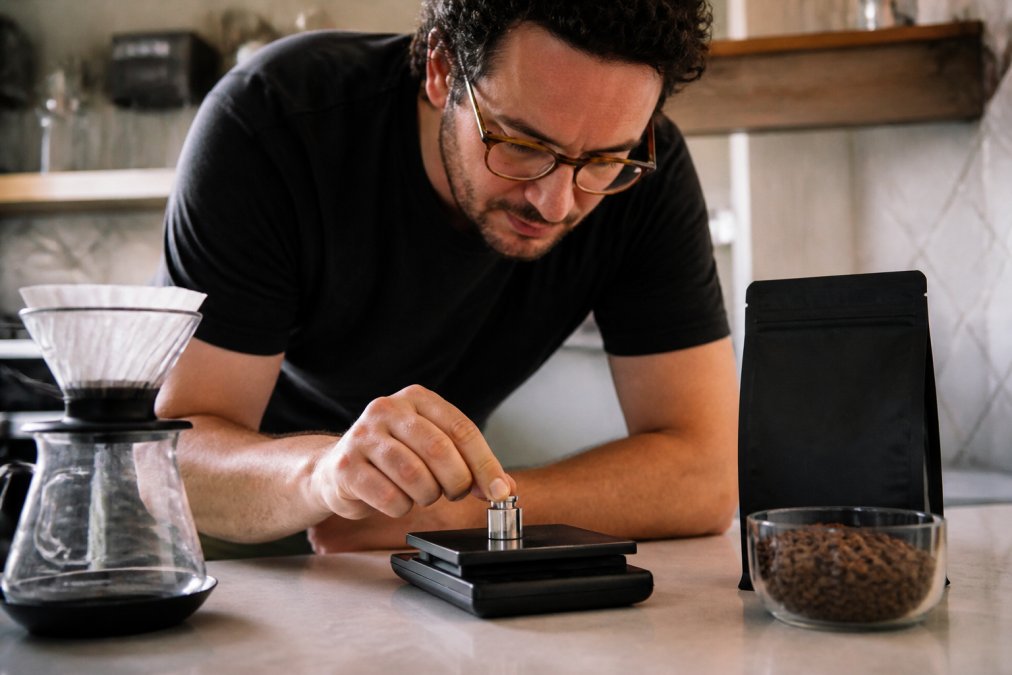
The process: warm the scale on a flat surface away from vents and speakers, hold the tare button until it reads zero, enter calibration mode, place the required weight dead center, wait for the display to lock, then re-check.
No certified weights? DIY options are less exact: twenty US nickels make a rough 100g check, 200ml of water is a 200g test, and a labeled 340g bean bag is a loose reference.
Vibration interference and temperature both move the reading, so a scale next to a running kettle or warm stove top drifts mid-brew. Move it, let it settle, then calibrate.
Coffee Scale Accuracy Test: Verify Before You Brew
A coffee scale accuracy test tells you whether your scale is still trustworthy, while calibration changes the setting. You can verify without touching calibration mode.
Run this check: place a known weight on the platform and note the reading, repeat three times watching for drift, press the tare button empty and confirm zero, then test at 100g and 500g to catch errors across the range.
If the reading is off by more than a gram or two, calibrate; if it holds steady, leave it alone. Over-calibrating introduces new error, so verify first.
How often should you calibrate a coffee scale?
Once a month for home use, plus a check after any drop, move, or big temperature swing; busy setups benefit from a weekly verify. Periodic maintenance beats a frantic fix on brew day.
What is the difference between zeroing and calibrating?
Zeroing, or taring, sets the display to zero so you can weigh beans in a container; calibrating adjusts the internal reference so readings match true weight. Zeroing is daily, calibration monthly.
A dot-matrix display can lag behind fast pours, so watch for a settled number before stopping the kettle, and keep the scale on a flat surface since a tilted platform throws off the load cell.
Consistency is the hardest part of home brewing, and a drifting scale undoes good technique faster than any other gear. Chilled Iguana Coffee Co. delivers fresh roasted, specialty-grade beans to your doorstep, so pair our curated roasts and cold brew blends with a scale you trust. Get started with Chilled Iguana Coffee Co. and taste what honest gram measurement does for your daily ritual.
Frequently Asked Questions
How often should I calibrate my coffee scale for consistent brewing?
For home baristas, calibrating once a month is a solid baseline. If you brew daily or notice your pour-over ratios tasting off, check accuracy weekly with a test weight. Coffee scale calibration frequency depends on use: heavy daily brewing, frequent moving of the scale, or temperature swings in your kitchen all shorten the interval. Mark it on your calendar so it becomes routine.
Can I use household items to calibrate a coffee scale?
Yes, but only for a rough coffee scale accuracy test, not true calibration. A sealed U.S. nickel weighs 5.0 grams, and a fresh dollar bill weighs about 1 gram. Stack five nickels for a 25-gram check. These are approximations because wear and moisture change weight slightly. For real precision, use certified calibration weights matched to your scale's capacity, like 100g or 500g.
Why is my coffee scale showing different weights for the same item?
Drift usually comes from three sources: a surface that is not flat, vibration from nearby appliances or your own hand, and temperature changes affecting the load cell. Move the scale to a stable, level counter away from the kettle, let it reach room temperature, then press tare and re-weigh. If readings still jump by more than 0.5 grams, the sensor may need recalibration or replacement.