



Table of Contents
- What Makes a Manual Coffee Grinder Worth Your Time
- Manual Coffee Grinder for Pour-Over: Finding Your Match
- Manual Coffee Grinder for Espresso: What You Need to Know
- Frequently Asked Questions
Last Updated: October 10, 2026
What Makes a Manual Coffee Grinder Worth Your Time
A manual coffee grinder is a hand-powered device that crushes coffee beans between burrs to create grounds for brewing, offering precision, portability, and control over grind consistency that rivals electric models at a fraction of the cost.
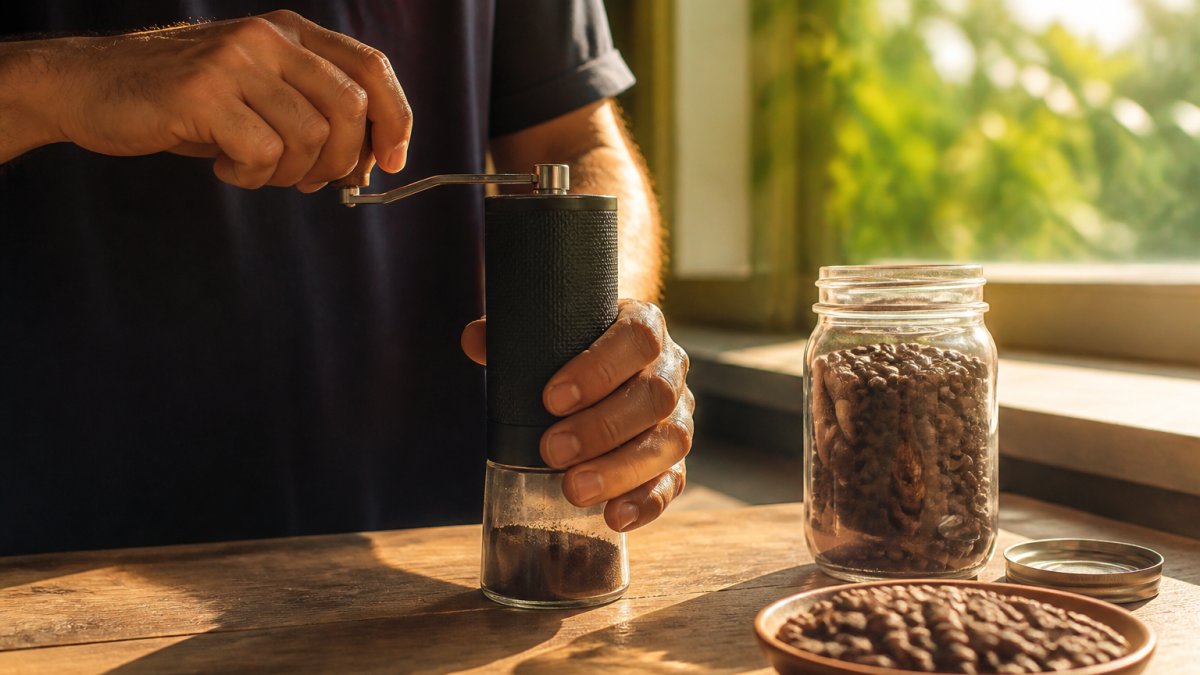
Burr type (conical or flat) determines uniformity; ceramic or steel burrs produce particle consistency that cheap electric grinders can't match.
Manual Coffee Grinder for Pour-Over: Finding Your Match
Pour-over brewing demands the medium-fine, consistent grounds that manual coffee grinders produce, flowing steadily through a filter.
Look for 15-20 grind-size settings with conical burrs to maintain particle uniformity.
Test crank handle ergonomics before buying, as comfort determines usability.
Manual Coffee Grinder for Espresso: What You Need to Know
Espresso demands fine, uniform grounds with minimal grind retention (grounds left inside after grinding), where manual grinders face their biggest challenge.
A manual coffee grinder built for espresso needs flat burrs and at least 40+ micro-settings for proper dialing.
Espresso-capable manual grinders require sustained pressure and take 3-5 minutes per shot; test crank handle ergonomics to avoid hand fatigue.
For espresso, minimize grind retention by choosing designs with smaller chambers between burrs and portafilter.
| Brew Method | Ideal Grind Size | Burr Type | Adjustment Range | Time to Grind |
|---|---|---|---|---|
| Pour-Over | Medium-Fine | Conical | 15-20 settings | 2-3 minutes |
| French Press | Coarse | Either | 10-15 settings | 2-3 minutes |
| Espresso | Fine | Flat | 40+ settings | 3-5 minutes |
| Cold Brew | Coarse | Either | 10-15 settings | 2-3 minutes |
The best manual coffee grinders deliver grind consistency and durability that connect you directly to your coffee. At Chilled Iguana Coffee Co., we source specialty-grade beans roasted fresh and designed to shine when ground just before brewing with a quality manual grinder that matches your brew method.
Frequently Asked Questions
What should I look for in a manual coffee grinder?
Focus on three things: burr type (conical or flat burrs produce uniform grind consistency), adjustment range (you need fine settings for espresso, coarser for French press), and capacity that fits your household brewing volume. Grind retention, how much coffee stays trapped inside, matters too; less retention means fresher grounds reach your cup. Check the crank handle ergonomics if you grind daily; a comfortable grip reduces hand fatigue.
Can a manual coffee grinder grind beans fine enough for espresso?
Yes, but not all manual grinders can. Look for burr grinders with a wide adjustment range that includes very fine settings. Conical burrs typically handle espresso better than flat burrs in hand grinders. Expect grinding to take 3-5 minutes for espresso-fine grounds, and test your grinder's consistency first, uneven particle size will hurt extraction and crema quality.
How often should I clean my manual coffee grinder?
Clean the removable parts (hopper, catch cup, burr chamber) weekly if you grind daily. Wipe the exterior and empty any retained grounds. Deep clean monthly by disassembling the burrs if the design allows. Never use water on the burrs themselves, oils will rust steel burrs. A soft brush and compressed air remove stubborn grounds. Proper maintenance extends durability and prevents stale-coffee flavors from building up.